Jill Scott | Golden (Kaytranada’s Life Living Edition)

When our very own Adam Rutledge had a sit down with Kaytranada before he took to the stage at Igloofest, Kevin Celestin mentioned that he rarely listens to new music. He’d rather listen to old disco and soul music like Diana Ross and Marvin Gaye (“or some rock music shit like Jeff Buckely”). And that appreciation for the classics is apparent in most of his work. Celestin knows exactly how to put his own spin on the tracks he works with while leaving just enough of the original groove to remind us just how good 90’s R&B really was.
His latest piece, a rework of Jill Scott’s “Golden” highlights just this. Listen and download below.

[Kaytranada]
See previously:
alh
Oneman | Interview

[Steve Bishop a.k.a. Oneman]
There is no denying that we have seen an influx of DJs over the past decade. In surprising contradiction though, we’ve also witnessed the diminishing of another species; what we’ll affectionately refer to as the DJ’s DJ. Steve Bishop, better known as DJ Oneman, is the epitome of this title and as such is but one of a few. Revered for his impeccable taste, honed turntable-isms, and ability to recontextualize the familiar into the novel, Oneman is perhaps even more eminent of a figure now than he has ever been. His name has many times graced the posters of Fabriclive, Boilerroom, Rinse FM, the Red Bull Music Academy, and now Igloofest, where we find shelter after his riotous performance to discuss the virtues of “Trap” music, the role of the DJ, and the future of UK dance movements, among other things. We hope you enjoy -
Low-Life: Igloofest… what is it? What’d you expect, what’d you get from it?
Oneman: I dunno what I expected.. I guess I expected an igloo. It’s good that there wasn’t one to be honest..
LL: I’ve read that one of the craziest parties you’ve played was in an igloo, back to back with Jackmaster, one deck, how did that compare to this?
Oneman: Ahh, that was so much better [laughs]. I can’t even begin to explain how much better that was. But yeah, like that was an experience in the igloo in Austria with Jack. And yeah, it fell to pieces; and this [Igloofest], stayed afloat. The boat stayed afloat.
LL: I guess that’s the beauty of not actually playing in an igloo. Having some actually structure.
Oneman: Yeah. Having a great stage, a good heating system for this weather..
“…if a whole new genre of music like dubstep came around… I really can’t see that happening again.”
LL: Changing the subject entirely – you’ve made a career out of being a DJ (among other things of course, label owner etc), do you think it’s still possible for an artist, a young guy coming up to make a name for themselves as that predominantly?
Oneman: I guess, well, it’s a lot harder now. When I did it, I was goin’ to clubs, I was meetin’ people in clubs, it was way more personal – not much internet involved. I’d meet people, and they’d give you a chance, because they believed in you, or they hear a mix of yours, or a radio show.
The scene was so small, that you could get away with it then. I feel like the only way that that could happen now, is if a whole new genre of music like dubstep came around; and I really can’t see that happening again. I feel like that could be the last big wave of a powerful music scene to come out of the UK, or anywhere really. I don’t think anything’s been as powerful as when dubstep came through, since. It was kind of: House, DnB, Garage, Grime for a little while, and then Dubstep. Since then, its just sort of been filler stuff. There’s never really been strong, powerful movement since then. So I think it can happen, but it’s a lot harder.
“That’s what I feel DJs should do if they’re producers. They should distance themselves from that production side of themselves.”
LL: I’ll quote you on this, you said: ‘I don’t think that the DJ is as needed or as important as when it started, all performance now is money.’ Do you think this has/will inevitably lower the bar for live performance? Essentially will it lower the bar for what a DJ is expected to do?
Oneman: Well, in a way I think yeah it’s already happened because, you used to rely on the DJ for new music. The producer couldn’t DJ. They’d have to learn how to DJ, where now it’s.. you know, a lot of producers have a copy of Ableton, and a controller, and they play their own tracks through that. Which is fine, and I have no problem with that, but it’s.. yeah it’s totally different deejayin’.. the bar would be lower, because expectations are completely different as to what they were.
LL: You’ve also said that one of your fortes is not necessarily relying on those unreleased tunes from your friends, it’s the talent in blending the existing tracks into something they’ve never heard before. Is that dwindling, or is there anyone out there still impressing you right now that can do that?
Oneman: There are a few DJs that I feel still do that sort of thing, like Jackmaster for instance, or Krystal Kleer – another great DJ that.. distances himself from his production style. That’s what I feel DJs should do if they’re producers. They should distance themselves from that production side of themselves. Not just like play all their hits, but you know, delve into what they like, or what they feel they could play against stuff. That’s what deejayin’ is I feel.
”['Trap'] reminds me of the energy that Grime had in the UK.”
LL: Just out there you played a lot of trap music: some classic stuff, Lex Luger, but also some from the more bursting phenomenon, Iggy Azalea, for instance. How do you feel about that movement?
Oneman: I feel like a lot of it has good energy.. and I feel like a lot of it has a relation to clubs. It’s club music. Bein’ the 808 beats, or the kind of straight rhythms, they have like.. set intro, set verse, set chorus. It’s good. It’s easy to play in a club, and it works. So yeah.. I mean, it reminds me of the energy that Grime had in the UK, from like 2000-2001. I hear the same sort of energy in a lot of the “trap” music.
LL: A couple weeks ago, you released a 119 bpm House edit of that xx tune, ‘Chained’. What provoked that, and can we expect more from you in the way of production?
Oneman: That was the Young Turks guys.. they asked Jamie [xx] to do a classic house edit of the ‘Chained’ track, and Jamie said “why don’t you ask Oneman to do it?” And then they asked me to do it, and I kind of played around with it for a bit, I had a few ideas, I used some UK Garage tracks and they didn’t really work, and then I settled on some old House stuff, and yeah.. I sent it to them, they liked it.. I think it’s good.
LL: Yeah, I think so too. One last one question – what gets you movin’ these days? What do you listen to on the plane, in the shower, whatever.. personally?
Oneman: Oh, at the moment, it’s the new Sasha Go Hard mixtape.. it’s sick. And it’s called ‘Round 3’ man.. and I dunno, she’s like one of the young Chicago girls like Katie Got Bandz. She’s really polite, she’s really nice.. she raps about her boyfriend, she raps about bein’ in love, she’s so sweet. I love her.. she’s great. She’s got good producers.. Block on Da Trakk, and another guy called Absolut P I think. Yeah, that’s my mixtape for the moment.
LL: Fantastic. Thank you for your time.
Oneman: A pleasure.

Cop both his Solitaire Mix and recent Edits compilation, free of charge:
[DL via images]
words: Samuel Rutledge
images/support: Kane Ocean
Kaytranada | Interview

[Kaytranada]
A few minutes before Montreal’s beloved Kevin Celestin took to Igloofest’s Sapporo stage, I got the opportunity to sit down and ask him a few questions. Kevin entered the small room with a humble demeanor and an anxious smile stretched across his face; Kaytranada was eager to get on stage, but more than happy to discuss topics not limited to: the city of Montreal, making music with family members, and trap music’s ever evolving fan-base beforehand.
Low-Life: Kevin, first of all, thank you for your time.
Kaytranada: No problem man.
LL: You were born in Port Au Prince (Haiti), and moved to Montreal shortly thereafter. On your Bandcamp, you list the city of Montreal to be one of your main influences… What aspects of this city influence your production most?
K: Well… It’s more about the nightlife in Montreal, It’s really dope, and everyone is open to everybody. There are all kinds of people here, its really nice.
LL: People dress the way they want to and such..
K: Yeah man, it’s dope.
“Supreme Laziness… It’s coming out soon. This year, probably March, maybe later.”
LL: From what I understand, your little brother has played an impactful role in your music career, introducing you to production and whatnot. What is the relationship like between you two?
K: Yo – he’s been my best friend since day one! Ever since he was born we’ve been really close… like really close.
LL: Absolutely man, I’m in the same place with my older brother. We would find new beats and wile out to them all the time.
K: That’s exactly the same shit man.
LL: And you’re working with him on a mix-tape I hear?
K: Yeah. Supreme Laziness… It’s coming out soon. This year, probably March, maybe later.
LL: What’s it like working with a family member?
K: Well, It is kind of like… kind of more direct, more emotional, you know. It’s always negative when we’re recording a track. Right now I’m not really down to record a track, because I don’t have that patience no more… He does a lot of takes when he’s recording his raps.. you know.. So I’m like fuck it. No more time, and now he’s kind of mad that I don’t want to record for him, or with him. I critique him and he’ll scream at me. But you know, at the end of the day, we’re just brothers arguing about a mix-tape and it doesn’t change anything.
LL: It’s all better the next day?
K: Yeah man.
“Its kinda weird for me cause I rarely listen to today’s music at all. I’m more into disco like Diana Ross, Soul music like Marvin Gaye or some rock music shit like Jeff Buckley.”
LL: So, for your forthcoming album, titled Kaytra Thomas, what kind of beats can we expect to groove to?
K: Yo. It’s gonna be everything… you’ve seen lately I’ve been into house… trap… hip-hop beats, its gonna be more complex with more suprises too.
LL: Can’t wait to hear it.
K: Haha thanks-
LL: The name you produce under, it started with Kaytradamus, and you changed it to Kaytranada… Kaytra, where did the ‘Kaytra’ come from?
K: Kaytradamus came from Nastradamus who took it from Nostradamus, and that was just kind of like random, it was a unique name at the time. So that’s where the Kaytra came from, it’s like a smaller name for my stage name.
LL: Correct me if I’m wrong, but you started DJ-ing prior to producing.
K: Yeah.
LL: Has any of the skills that you acquired from DJ-ing transferred over to your production process?
K: Well yeah, it kinda helped for mixing, and more creative stuff with effects. At that time I didn’t even know how production worked so i learned everything from there. The BPMs, mixing acapellas and all of that.
LL: So tell me your ideal setting for working on a track? 4 in the morning.. a sunny afternoon.. Snowfall perhaps? What’s the ideal?
K: Well, back in the day I usually worked early in the morning, like at 4am when I didn’t sleep at all. I had pretty bad insomnia; I was an insomniac for a really long time. I’m kind of recovering from it now, but back then it worked really well to make beats during the night. Now today, it only happens one time a week when im about to go to sleep or when i come back from school.
LL: Do you have any other passions besides music?
K: Yeah sure, i freaking love drawing and i also love filming and directing videos. I have a passion for food too.
LL: Your top 5 artists in the game right now?
K: TNGHT… Kendrick Lamar… Sean Price… umm… Action Bronson… Schoolboy Q… Its kinda weird for me cause I rarely listen to today’s music at all. I’m more into disco like Diana Ross, Soul music like Marvin Gaye or some rock music shit like Jeff Buckley. So right now, I’m catching on the albums that I’ve missed in the past years whether its from the 90′s, 80′s or the 70′s.
“I don’t hate the musicians who make trap but I think the fans are getting annoying and corny only waiting for a drop or saying “its a trap”. I don’t think its trap, it supposed to be a sub genre for hip hop.”
LL: Where do you look to find new music for your sets?
K: SoundCloud. Just discovering new music, scrolling up and down. I look for new artists; I look for new shit, original stuff. Then when I discover a new artist I dig, I check out his favorites and it links me to other artists that I’ve never heard of, which is amazing.
LL: Last question, what’s your outlook on the trap-music scene looking forward?
K: I don’t know, its getting kind of weird. I don’t hate the musicians who make trap but I think the fans are getting annoying and corny only waiting for a drop or saying “its a trap”. I don’t think its trap, it supposed to be a sub genre for hip hop.
LL: I’m looking forward to your set, thank you very much for your time Kevin.
K: Yo thanks man. That was cool.

See Previously:
Kaytranada | Kaytra Todo EP
Igloofest | Retrospective
words: Adam Rutledge
images: Kane Ocean
Igloofest 2013 | Preview

With the New Year rung in and the Holiday affectations revoked from their store windows, the majority of cities now enter the long drudge through Winter toward the joviality of Spring.
Montreal is the exception.
Here, the people disregard the common sensibility to sulk and hibernate, and choose instead to revel in sub-zero outdoor communion, an habitual observance of the arts. Igloofest, Montreal’s own alfresco dance-party, is but the essential representation of this mass delusion; a passion for the extreme, the creative, and the cutting-edge.

Now, entering its 7th year, the party boasts a number of achievements. For one, it has earned the affectionate title of “World’s Coldest Festival,” seeing high spirits at temperatures as low -32° C. Igloofest‘s setting is a triumph in and of itself. Posed against the back drop of the St. Lawrence river, the Quay’s of Montreal’s Old Port dazzle with the help of LED displays numbered in the thousands, not to mention the dozens of featured visual artists set to perform in unison with the musicians on stage. The entire operation has grown from a modest 4,000 party goers in ’07 to welcoming an excess of 55,000 bodies last year. This influx in festivity is likely due in part to the renowned list of talent being selected by those also behind Monteral’s praised summer-jam, Piknic Electronique. I would begin to account the impressive performance alumni of recent years but the list would prove too long for any sensible inclusion. Instead, let us walk through some of Low-Life’s most anticipated, (in alphabetical order) -
A Tribe Called Red

“A Tribe Called Red is a group consisting of three DJ’s, all of which are from a Native Canadian background. Hailing from Ottawa, Canada, ‘the Tribe’ strives to blend contemporary club sounds with their own traditional Pow-Wow music. The singing found in the original Pow-Wow music is something that cannot be replicated, yelps and screeches hit evoking tones with a strong sense of soul… absolutely refreshing.” (via Low-Life)
A Tribe Called Red plays the Sapporo Stage on January 31st.
Ben UFO

Ben UFO makes up one-third of the contemporary behemoth Hessle Audio, along side other young moguls Pangea and Pearson Sound. He is considered a particularly rare case these days as he is one of an increasingly small contingent of touring artists that only DJ and are respected as such, never taking public steps into the world of production.
Ben UFO takes the Sapporo Stage, February 7th.
Joe Goddard (of Hot Chip)

Joe Goddard may be more commonly recognized as the synth-line and vocal layer to the indie giant, Hot Chip, but something he’s also esteemed for is his unique taste in funk, disco, and the clubbier side of electronic music.
Joe Goddard will take the Sapporo Stage, February 7th.
Joy Orbison

Right now, Joy Orbison is a powerful figure in the house music bubble. This is likely due to the consistency in which he churns out certifiable underground classics. Since his debut single, ‘Hyph Mngo’ in 2009, Joy O has been and continues to be a thunderous and groovy force.
Joy Orbison will play the Sapporo Stage, February 8th.
Kaytranada

“Montreal’s own Kaytranada has a certain way with R&B originals. Listing his influence as “The city of Montreal… mostly,” Kaytranada is becoming more and more relevant… with each passing day; from opening for Baauer and Araabmuzik…reworking tracks for Montreal’s Booty Bakery, and now working with LA based label, HW&W Recordings” (via Low-Life)
Kaytranada will take the Sapporo Stage, January 26th.
KiNK

KiNK may very well be Eastern Europe’s premier source for acid-house, not to mention for his own unique brand of a whimsical techno. Since the inception of his musical passion in 1992, and the commencement of his career in 2000, KiNK has finally -in recent years- become a name synonymous with classic sound, quality, and, paradoxically, the cutting edge of dance music.
KiNK will play the Sapporo Stage, January 18th.
Nina Kraviz

It is funny that Nina Kraviz maintains so many out-spoken qualms with perfection, that is considering her profession as a both producer and DJ require some level of said quality, but she does, and this likely is a source for her undeniably unique approach to the common house music mode. She is also a bomb-shell. See for yourself.
Nina Kraviz will play the Sapporo Stage, January 25th.
Oneman

Yet another ‘pure DJ,’ in that he only DJ’s, with no production to call his own. This, of course, is of no consequence to his reputation because the name ‘Oneman,’ is a name that garners immediate respect from listeners across the UK and beyond; because everyone knows that Oneman has the hottest dubs out.
Oneman plays the Sapporo Stage on February 8th.
TNGHT

TNGHT, the duo comprised of Scotland’s Hudson Mohawke and Montreal’s own Lunice need little introduction. The TNGHT EP was heard around the world. There is no doubt that this performance will be altogether insane.
TNGHT will take the Sapporo Stage, January 26th.
Wolf + Lamb

Lastly, we have Wolf + Lamb. The Brooklyn based outfit is posed to bring out its signature style of deep, melodic, indie-sexual house music. Bring your special someone along to this one and make some eye-contact.
Wolf + Lamb will take the Sapporo Stage, January 17th.

Seeing as Igloofest 2013 is not three, but a full four weekends long this year, there is really no excuse for missing out. From out of town, from out of the basement, don your snow gear and prepare to dance. You won’t regret it. Trust us.
Tickets can be purchased by day, by weekend, or by full pass at igloofest.ca
sam.i.am
Kaytranada | Holy Hole Inna Donut

[Kaytranada]
Montreal’s Kaytranada released a freebie for followers earlier this morning; a track off of his forthcoming LP for HW&W recordings. Holy Hole Inna Donut’s strongest point is following the breakdown, when all of the beat’s elements come together and sing for a final time. The beat is invigorating yet not overly obnoxious, surely deserved of a place in your electronic library.
Be sure to catch Kaytranada at Montreal’s Igloofest on the night of January the 26th, suitably warming up the stage for beat-scene supergroup, TNGHT.
See previously: Janet Jackson | If (Kaytranada Remix)
Atom
Janet Jackson | If (Kaytranada Remix)

[Kaytranada]
Montreal’s own Kaytranada has a certain way with R&B originals. Listing his influence as “The city of Montreal… mostly” Kaytranada is becoming more and more relevant in the tasteful electronic music scene with each passing day; from opening for Baauer and Araabmuzik last weekend, to reworking tracks for Montreal’s Booty Bakery, and playing a set at Montreal’s forthcoming Igloofest. His spike in publicity did not come undeservedly either, take a listen to Kaytranada’s funky rework of Janet Jackson’s If below.
Be sure to keep an eye on to this up and coming talent.
Atom
French Fries | Interview

This February past, I had the chance to catch up with Valentino Cazani, the bass-music chameleon, French Fries, at Montreal’s internationally renowned Igloofest. In an effortlessly cool accent, he discusses what would come to be his triumphant Yo Vogue EP, his passionate relationship with “Ghetto” music, and his big sister’s super cool petit ami.
With out further ado, I welcome French Fries -
LL: What were you looking forward to in playing Montreal this evening?
FF: Euuh, well, I knew it was crazy (laughs) ‘cuz I heard about the festival. I just knew it was crazy and it was really cold.
LL: Evidently.
FF: Ya, I was really looking forward to ‘dis gig.
LL: What are you working on now; what are you hoping to produce in 2012?
FF: I have a next EP forthcoming on Dirtybird with a remix from Claude Von Stroke and a Leroy Peppers. And then we’re producing my sister’s album with Bambounou. Its kind of like R&B-Rap. So we have an EP coming, ‘den a mixtape, ‘den an album.
LL: Keepin’ busy.
FF: Yeah yeah.
LL: Where do you find yourself drawing influences from to make these records?
FF: Which one?
LL: All of them.
FF: Euuh, Ghetto music really (laughs).
LL: Yeah?
FF: Yeah, Ghetto music from the UK, from Paris and America.
LL: Can you name names?
FF: Names? Sure: Pearson Sound, all the Dirtybird crew, that new Detroit – Chicago house scene, the UK scene obviously, and this big French move in Paris right now, like Sound Pelligrino, Young Gunz, Clek Clek Boom, which is my label, Brodinski as well.
LL: You mention the French movement going on right now; How do you think it defines itself in comparison to the American and UK movements. What makes the French movement unique?
FF: Everyone has his culture, right? I think the UK is bass-music, Garage, and that kind of stuff. America is really Ghetto, like Baltimore, Jersey, ‘dis kind of stuff. And Paris, I think is more a House scene. And we just try to mix everything with the house culture we have. So we try to mix the UK scene with our thing, and the Ghetto scene as well.
LL: I’d like to know about how you started in this industry; what first piece of hardware you bought? What were you listening to back then?
FF: Well basically, my father is sound engineer so I just grew up in a studio. I’ve just been playing when I was a kid, making rap-beats when I was like 10.
LL: 10?
FF: Yeah, it was shit though (laughs). But you know, I’ve just been playing. And I just started DJ-ing when I was fourteen.
LL: And you’re how old now?
FF: I am twenty. So I’ve been six years. And cuz ‘dese guy, euh, Ministre X; Tchiky Al Dente, use to date my sister six years ago, and he’s a dj. And I was like: “Eugh, DJ. That looks so cool!” I was like “Can you teach me scratch and stuff?” And I just went to his club, Favela Chique, and, uh, he teach me how to play. I stay there for basically two years – had a residency. And, uh, I just began to make House music.
LL: And you were listening to the House music of, well, 2004, I guess, when you had this residency.
FF: Actually, I was listening to, uh, Ghetto music (laughs harder). Again, I was listening to Chicago house, Baltimore club music, and uh, Baile funk, the Ghetto music of Brazil – from Rio. He’s from Brazil, Ministre X, and I’m from South America, Uruguay.
LL: Thank you for your time, Valentino.
FF: Thank you, Low-Life.
“I wanna see you vogue, bitch.”
French Fries’ Yo Vogue EP -
And here’s a riveting mix that features Doc Daneeka and the man himself, put out only yesterday.
sam.i.am
Mala | Interview
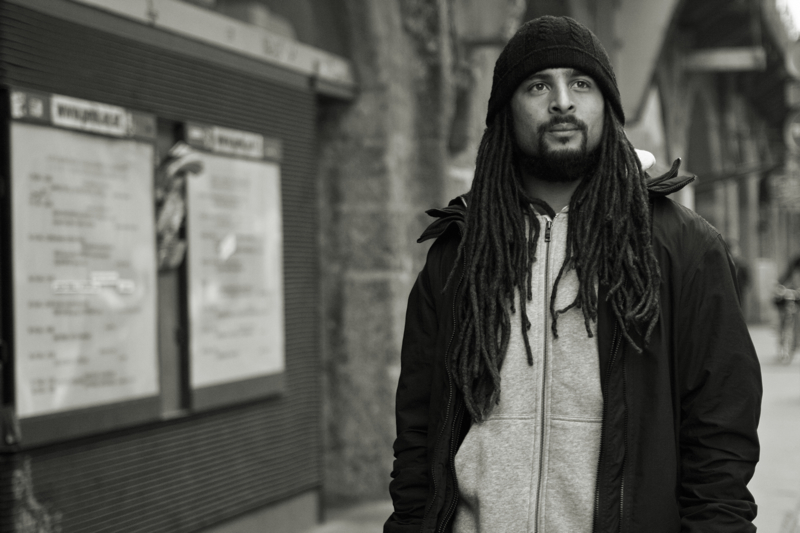
Escaping the frost-biting winds of Montreal’s Old Port at the world’s hottest sub-zero festival, Igloofest, I was blessed with opportunity to converse with a legend in the sanctuary of a booze-riddled trailer, heated with its own external generator. Member of Digital Mystikz, co-founder of DMZ, and creator of Deep Medi, Mark Lawrence is one of the few bonafide pioneers of a genre we’ve come to know and love. Take your time and digest his teachings because it is a veritable rarity to learn a history from the mouth its author.
LL: What were you looking forward to coming to Montreal?
M: When I play shows, its always the same things really. You never know what to expect in places, so. The reason why I enjoy doin’ what I do is because of people and because of music. And its about bringing them two together. So that’s why I enjoyed comin’ here. I knew it was guna be really cold as well.
LL: I can see you that you brought your jacket.
M: I actually bought a jacket at the airport. Cus it had some 50% sale on.
LL: I didn’t know you could buy jackets at the airport.
M: It was in Belgium actually I bought the jacket. Lucky I did cuz I knew it was gunna be cold out here, but yesterday was cold man.
LL: Balls cold.
M: Yeah.
LL: Anyway, I’ve heard from a little bird called the internet that you recently, or are planning to go down to Cuba with your friend, Mr. Giles Peterson. I was wondering what’s going to come from that Cuban influence.
M: Um. I went to Cuba twice last year to work on this project. I worked with a guy called Roberto Fonseca and his band. If you check this guy out; If you check a lot of musicians out in Cuba, their ability to do what they do is unbelievable. Overwhelming actually, because I don’t really see myself as a musician.
LL: No?
M: When I get on the computer and make music, to me, its like playin’ computer games. Ya know, I’m from that Nintendo generation.
LL: Donkey Kong, Super Mario..
M: You know what I’m sayin’. I see music in maybe a different way from those guys because they understand music in terms of it being pitch perfect as well as musical scales and those things there.
LL: They’ve been clapping the clave since they were in diapers.
M: Ya man, unbelievable. So you know what I mean? I didn’t know what to expect. And I still don’t know really what to expect. Cuz, you know, the album’s still building. So, you’ll just have to wait and see.
LL: We most certainly will. So how did you start up that relationship with Giles?
M: Like most of the things, just through music. It reaches people and, ya know, someone like Giles, he’s championed so much music over the years. You know, that guy. When you see his record collection… And I know for a fact that I’ve probably only seen a quarter of it. It’s ridiculous. And I was very lucky that he invited me a couple of times to his Radio One show and I did a Brownwood’s podcast with him. And yea, just bouncin’ like that. Ya know what I mean?
LL: Yea.
M: He’s been doing this work in Cuba.
LL: Mutual respect.
M: Yea, its just one of those things. Luckily, he decided to bring me with him on his adventure, ya know.
LL: Ya. So, now, who do you find yourself being influenced by? Other than the musicians of Cuba, of course. But, present day, what are you listening to and making music after you listen to it?
M: I listen to so much music and I’m on the road a lot as well, its not always music that influences or inspires me. Its more the experience of people and places and certain things that happen. So, its kind of a difficult question to answer now a-days because, ya know, if you’d go back to when I first started writing music, there could be definite musicians and producers and I could say ‘Yea, I draw influences from these guys.” But now, I’ve been doing it for so long, I don’t even know what happens. This is just what it is, ya know. It’s who I am.
LL: Yea… you see a piece of art. You see a building…
M: You know what I mean.
LL: Absolutely. You mentioned earlier that you could pinpoint things that influenced you back then better than you can now, so what were the things that influenced you?
M: The main thing was Jungle music. You know, I grew up as a teenager early in the 90’s and Jungle was on a lot of pirate radio stations. So when I started hearing hard-core Jungle in ’92-’93 it was that sound there that made me wanna get involved in music, some how. You know what I mean? I didn’t know how at first. It was just something that like kind of just overwhelmed, overwhelmed me. And from that I kept listening and kept searchin’ for new sounds and somehow I just started tinkering, ya know what I mean? But, Jungle was an interesting sound ‘cuz those guys there, they drew influences from everywhere, so you’d hear like a Roots or a Reggae sample in there, or you’d hear a Hip-Hop sample, or you’d hear some Acid, or you’ll hear some Jazz, ya know? You just heard everything. And from Jungle music, that expanded my mind really, and I just started diggin’ deep all over. No prejudice, ya know what I mean?
LL: Absolutley.
M: You neva’ know what you’re gonna’ like so I never not listen to nuffing, whenever someone sends me something to have a listen to. I always have a listen.
LL: What brought you to the co-founding of DMZ?
M: Again, it was just meant to be, really. Ya know, I’ve known Coki and Pokes since I was about 11 years old. We went to the same school. We lived in the same area. So we was always doin’ music from young growin’ up. MC’n. Swappin’ tapes. Goin’ to each other’s yard and jamming. We used to play a lot of parties in the area. At a young age we’d become residents at like, under-18 (‘una-ay-een’) clubs. We’d play with people like Mickey Finn, and Kenney Ken, and Randall, Jumpin’ Jack Frost, and Groove Rider. You know, this is when we were like 14-15 years old. We’d MC for these guys, and we met Loefah when we was about 15-16, and what I found is, you know, you probably find it for yourself, a lot of your friends, your common thing that you all love and how you became friends is music (*big grin). And from then your like-minded and you go on a path together. It was just one of those things. We found that we were in a time in London, where the Jungle thing had changed, the Drum and Bass thing was doing its thing. We used to go to a lot of Metalhead’s parties and that. And it just got to a point when we were all making music and there was nothing really happening. We weren’t interested in signing records to major record labels or anything like that. It was… I always think, its very difficult because when you are creative or whenever you want to present something to somebody, when other people get involved, whether it be a distribution company, a record label, or a PR company, or whatever. You have to be very careful, I think, when you’re coming through, that you don’t get misrepresented. We were very, very conscious not to be misrepresented with we we’re doin’ because what we were doing, it wasn’t this and it wasn’t that. It wasn’t Jungle. It wasn’t house. It wasn’t Techno. It wasn’t Garage. It was this. It was a DMZ t’ing. So it only made sense for us to just start up our own thing and start up our own parties. Ya know what I mean? It was just like that really. Just because, you know, Big Apple brought us through. People, you know, Hatcha, Artwork used to also be at Big Apple Records. Jon that used to own Big Apple Records. You know, we would take our tunes down there, and it was Hatcha that first started cuttin’ our tunes onto dubs. And unfortunately Big Apple closed. They released our first record and about 6 months later they closed. So that’s why we just started, we were gunna do our own thing – press off 500 records and see what happened. It trickled through. I remember goin’ to record shops and people bein’ like, “Nah. We can’t sell this. We don’t know what it is.” So we’d take anotha’ and by about DMZ004, I remember goin’ to Soul Jazz Records, dropped off a box of records, and didn’t even get back home – I was on the underground – I went to go back home, and by the time I got off the train there was a voicemail sayin’, “We’ve already sold out. Can you bring us another box?”
LL: Big day.
M: Yea from then, there was a feeling that people started to understand what the music was dealin’ with. At parties – people would come down to our parties and they would just vibe, ya know. There was a certain type of person that’d come down to the vibe, and that just spread out, ya know? I mean, It was just a word of mouth thing; it was an underground thing. It wasn’t just what we were doin’. It was what Kode9 was doin’. It was what Skream was doin’. It was what Plastician was doin’. And people like Chef.
LL: It was the whole movement.
M: It was everyone. We were all together, all buildin’ tunes. It was like sparrin’ with each other. You know what I mean?
LL: Some competition…
M: Not even competition because I don’t see myself or music as competition.
LL: Friendly…
M: Yea. And I hear someone’s tune and its sick and I’m just like “ Wouahh! Right. Bam! Go back in the studio,” like, “Yeah! Wus’goin’ on?” It was that. It was that. It wasn’t just us four that built DMZ in my opinion. It was everyone that’d come to our dance and brought their friend, or every journalist that said, “Yeah. DMZ is this or that.” Or every photographer that came down and took a picture. You know, DMZ is a universal thing. For everyone, nah mean? No prejudice man.
LL: In that case, Why Deep Medi after DMZ?
M: Well, at that time, I was getting sent a lot of music and I was finding that when I was goin’ into record shops and people would be kind-of wanting to listen to what was coming out of DMZ or what us guys were doin’. I was doin’ youth work at the time so it was just where my head was at the time. If I can help otha’ people with the music that they’re doin’ and share it and spread it out , then I’m goin’ to try to do that. I didn’t want Deep Medi to be a side line of DMZ. I didn’t actually tell people that Deep Medi was my label until about 2 years after.
LL: 2 years after the creation?
M: Yeah. So I just wanted the music to speak for itself. I wanted the producer’s, ya know, their music to be recognised in their own right, and not like, “Oh. Its comin’ from DMZ or Mala, so it must be x, y, z.” So I just wanted it to be clean for them on the label. And I think all them, everyone that’s been on the label has gone and played shows around the world. You know, its just if I can get people out, if together we can everyone out, to be self-sufficient, one way or another, I think that’s a good thing.
LL: A very fucking good thing.
M: Cause no one wants to be doin’ this 9 to 5 grind, doin’ things they don’t enjoy doin’. So if I can help people do what they love doin’ then….
LL: That’s noble of you.
M: Nah man its not like that. Its just the way things worked out. It’s a blessing, you know what I mean?
LL: Yeah. So what do you see in the next 2, the next 5 years, whatever, for this genre that you helped pioneer? What’s out there?
M: I never knew what was comin’. I don’t what’s comin’ now. So, you know, I love what I do. I feel very lucky to be able to do what I do. With that mind set I’ll continue to explore and to keep pressin’ in whatever direction I go, ya know? I try not to follow, n’ah mean. Just go wherever it feels right.
LL: Thanks Mark. That was phenomenal.
M: Thank you.
sam.i.am
L O W – L I F E
Igloofest 2012 | Montreal, QC, Canada

So concludes the 6th edition of Montreal’s beloved Igloofest, resurrecting the eternal wisdom of icon, Dr. Seuss. “Don’t cry because its over, smile because it happened,” he once so empathically advised. While melodramatic indeed, the sentiment of this phrase will surely ring true in the psyches of any snow-suited enthusiast that revelled in the lights, vibrations, and atmosphere of the so affectionately termed, world’s coldest festival.

While the allure of this experience must really be endured first-hand, I’ll try my best to portray a picture of this surreal celebration.

Imagine thousands of bodies, donned in various hues of neon, writhing and grooving to the rhythms and tones of the world-class dance-music being propelled out of a veritable fortress of speakers and subs, steam flowing upwards from the audience as snow flecks mimic a perma-confetti lit up by a constantly evolving barrage of L.E.D. images that span across the outdoor arena that overlooks the enchanting St. Lawrence river and Montreal’s famous Old Port. Now, once this image has settled in your head, picture not one, but nine nights of this entirely unique experience, bridging three weekends of late January.

But beyond the astounding environment, what really earns Igloofest a place in the hearts of Low-Life is the almost unparalleled selection of producers and DJ’s from around the world. Thanks to a truly experienced team that are also responsible for the locally cherished Piknic Electronik, Igloofest welcomes artists both unknown and legendary, established and up-and-coming, from an array of electronic genres. Each night, in fact, is cleverly, though loosely categorized by a theme, allowing for the effortless discovery of new music via associated style.

Something for every taste, this year’s festival featured varieties and sub-genres of techno and house, predominantly, with a touch of dubstep, though labelling individual sounds always proves difficult. Pictured chronologically below are our most esteemed performances. Please find further information about the artists through the links provided below each photograph.

[Mala][Tiefschwarz]
[Bambounou]
[French Fries]
[Pearson Sound]
[Maya Jane Coles]
[Green Velvet]
[Ben Klock & Marcel Dettmann]
See you next year,
sam.i.am


[
[
[
[
[
[
[